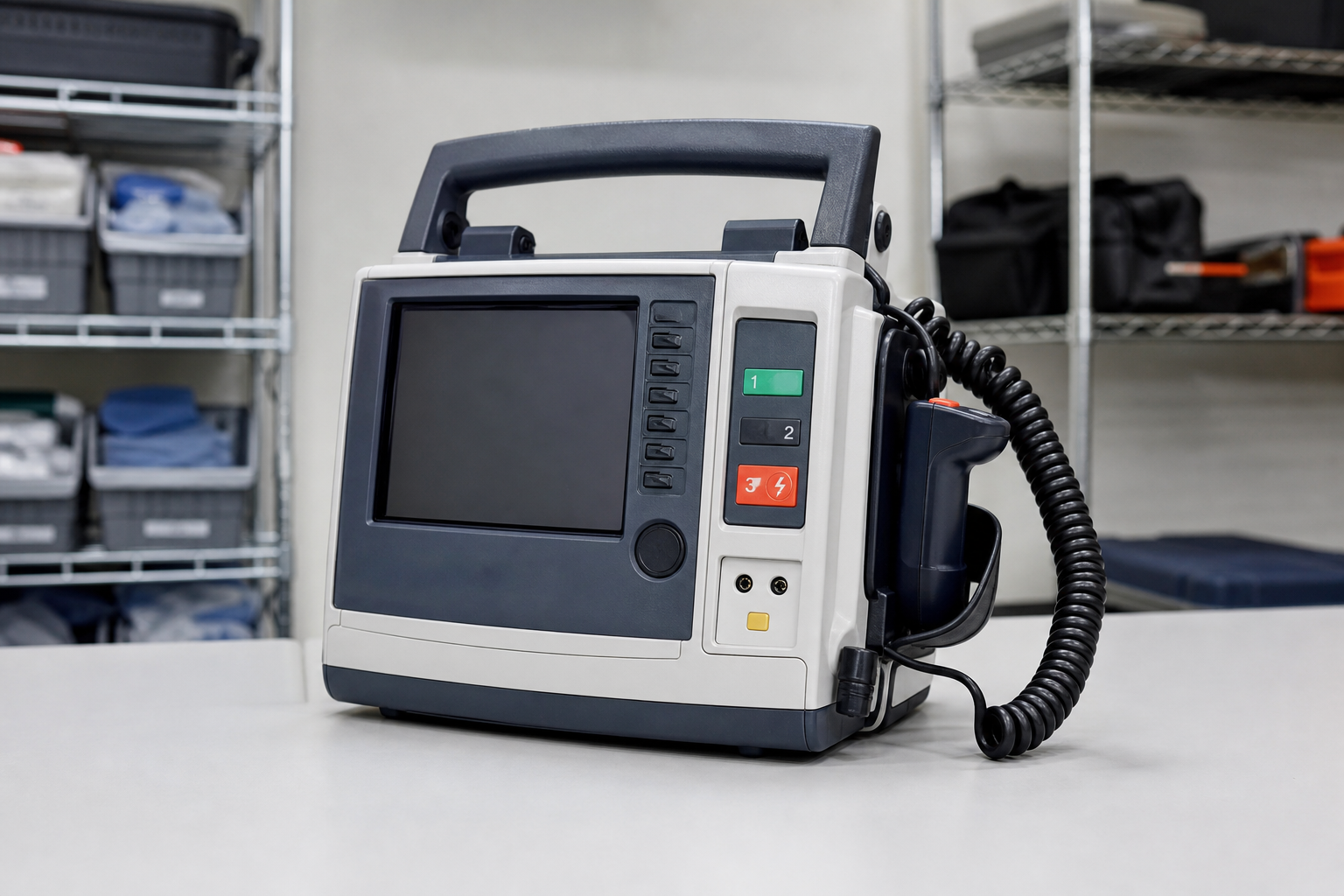
A refurbished defibrillator can be the sensible buy when you need readiness, not showroom condition. However, the headline price rarely tells the full story. Pads, electrodes and batteries carry printed dates. Self-tests and service actions leave records. Accessories can add real replacement cost. So, before you compare a serviced used unit with a new entry-level model, ask the seller to show what expires, what logs exist, and what has been checked before payment. That applies to both AEDs and professional monitor-defibrillators.
AED or professional monitor-defibrillator: which one does your setting actually need?
Start with the use case, because an AED and a professional monitor-defibrillator solve different procurement problems. An AED is built around guided operation and routine readiness checks. By contrast, a professional monitor-defibrillator is usually chosen by hospitals, ambulance services and trained clinical teams that need a display, broader monitoring functions or a paddles-based workflow already defined by local protocol.
That difference matters when you buy used. Most online checklists focus only on public-access AEDs. Yet a clinic or emergency department may be comparing refurbished AED devices with older monitor-defibrillators from established hospital fleets. In addition, some buyers are sourcing alongside other resuscitation support equipment from the cardiac assist equipment category, so standardisation across accessories, service routines and staff training often matters more than purchase price alone.
Keep the decision practical. Match the device type to your trained users, your existing fleet, your storage environment and your replacement-parts plan. Then ask each seller for the exact model designation, installed accessories and part references included in the sale. Do not assume cross-compatibility. Pads, batteries, cables and printers can be model-specific, and the buyer should confirm every part reference against the manufacturer documentation for that exact unit.
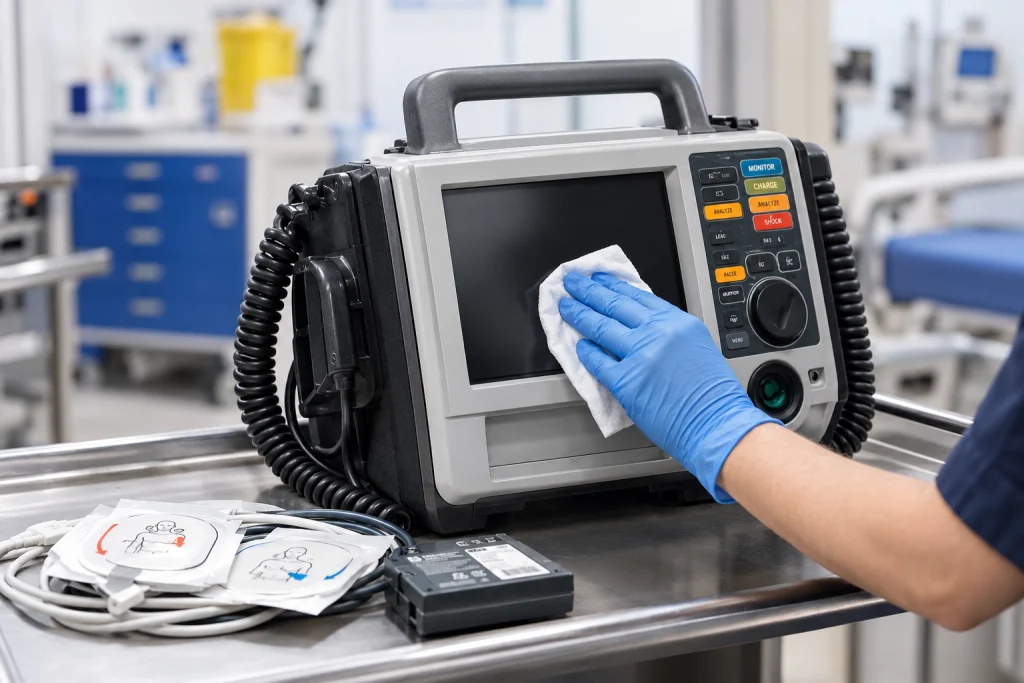
What do the pads, electrodes and battery cost, and when do they expire?
This is where many refurbished purchases become expensive in year one. AED electrode pads are consumables with printed expiry dates, and the American Heart Association advises owners to check pad expiration dates regularly and maintain the unit according to the manufacturer’s instructions. The same guide notes that pad gel can degrade over time, which is why unopened packaging and date visibility matter during inspection. The American Heart Association’s AED implementation guidance is a useful reference point for building your own receiving checklist.
Ask the seller for photos of every dated item before you commit. That means pads or electrodes, installed battery packs, spare batteries if included, and any sealed accessory kits that will sit in storage after delivery. If the labels are not legible, ask for replacement stock or a written exclusion so you can price the true landed cost yourself.
For AEDs, the self-test system often checks whether pads and batteries are still within their dates. For example, ZOLL’s AED 3 documentation states that its self-test can detect expired pads and a battery past its install-by date, and the device uses a visible readiness indicator to show whether it passed self-test. That is useful, but it does not remove the need to inspect the printed dates on the actual consumables supplied with the unit.
For professional monitor-defibrillators, the same principle applies even if the accessory set looks more substantial. Paddles may be reusable, but electrodes, battery modules, recorder paper and model-specific cables can still drive early replacement cost. Therefore, ask for a line-by-line list of what is included, what is reusable, what is single-use, and which items the seller expects you to replace immediately after receipt.
If you are comparing a new entry-level AED with a refurbished defibrillator from a premium platform, build a first-year consumables sheet. Include replacement pads, replacement batteries, any adapter or therapy cable you will need, and any missing dock, charger or printer accessory. That comparison is often more useful than the ticket price alone.
What should the seller demonstrate – self-test records, energy delivery, service history?
Before payment, ask the seller to demonstrate readiness in a way that matches the device class. With an AED, request a current readiness indicator, the result of the latest automatic or manual self-test where available, and any accessible event or maintenance log the unit stores. Some manufacturers explicitly describe self-tests that verify electronics, charging and discharge functions, and date checks for pads and batteries.
With a professional monitor-defibrillator, ask for more than a power-on photo. Request written service history, evidence of the last workshop inspection, and confirmation that energy-output verification was performed using appropriate test equipment by a qualified technician. If the seller cannot provide that evidence, treat the unit as needing incoming technical evaluation before clinical deployment.
Be precise about what you want in writing:
- The exact model and serial number.
- The installed software version if the device displays one.
- The accessories included in the sale, by part reference where possible.
- The date of the last service intervention or inspection the seller can document.
- Whether the device passes its built-in self-test at handover.
- Whether an external energy-output or performance check was completed before sale.
- Any faults, cosmetic damage or missing accessories known to the seller.
Also, separate seller checks from buyer responsibility. Acceptance testing, energy-output verification after receipt and any periodic electrical or safety testing required by your facility remain the buyer’s responsibility and should be carried out by a qualified biomedical technician. In other words, seller paperwork is helpful, but it does not replace your own incoming inspection or your local maintenance programme.
For hospital and ambulance buyers, ask whether logs can be exported or viewed during inspection. A stored service or self-test history can help you spot a unit that has spent long periods inactive, has recurring advisories or has missing maintenance continuity. However, if records are unavailable on an older platform, insist on a clear written statement of exactly what was tested before sale and exactly what was not.
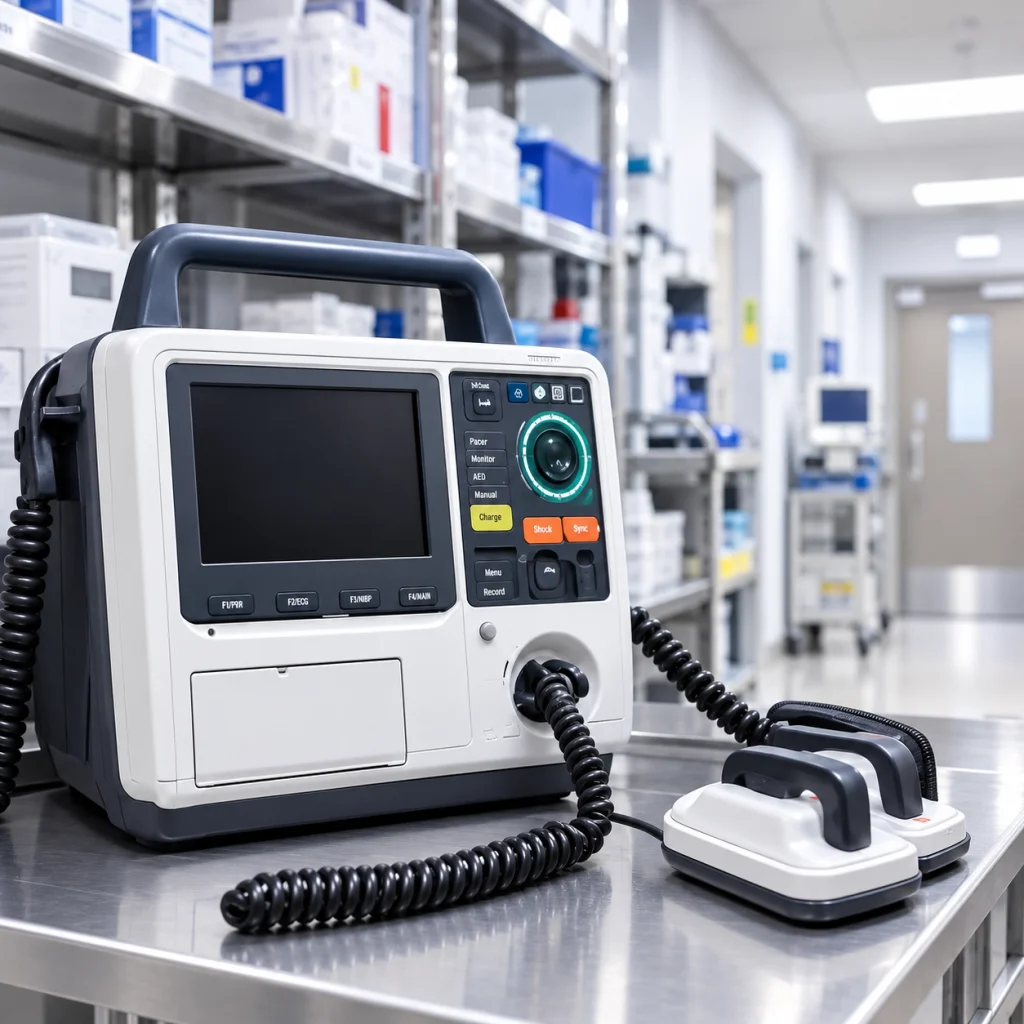
What physical and accessory checks decide whether the unit is worth the money?
Physical condition matters because damage often shows up first on the parts staff handle every day. Start with the housing. Look for cracks, heavy impact marks, broken latches, missing seals, loose battery doors and worn connector ports. Then inspect the carry handle, screen, buttons, rotary controls and status indicators. A cheap unit with damaged casework may become expensive once you price replacement plastics, doors or mounts.
Next, check the therapy accessories. On a professional monitor-defibrillator, inspect paddles for cracks, cable strain, corrosion, worn release buttons and signs of rough rework. On an AED, inspect the pad connector, storage compartment and cable routing. In both cases, confirm that the included accessories are the correct ones for that exact model, not simply items from the same brand family.
Then review the support items that affect day-to-day ownership:
- Battery charger or dock, if the model uses one.
- Power supply and mains cable.
- ECG or therapy cables, if applicable to that platform.
- Printer module and paper support, where fitted.
- Mounting brackets, carry cases or vehicle fixtures if they are part of your use case.
- User documentation or access to the relevant operator manual.
Finally, ask the seller to power the device up in front of you or on video, show the status indicator, navigate the basic menus and demonstrate that included accessories are recognised by the unit where that can be checked non-clinically. For an AED, a failed or blank readiness indicator is a clear warning sign in manufacturer documentation. For older monitor-defibrillators, unexplained alarms, dim displays, weak battery retention or non-working printers usually mean extra cost is coming.
A practical summary: buy the refurbished defibrillator with the clearest dates, the strongest documentation and the fewest unknowns, not simply the lowest price. Check every consumable label, ask for logs and written disclosures, and have a qualified biomedical technician complete acceptance testing after delivery. That approach gives you a defendable buying decision and a more realistic first-year cost picture.
Ratings and Reviews