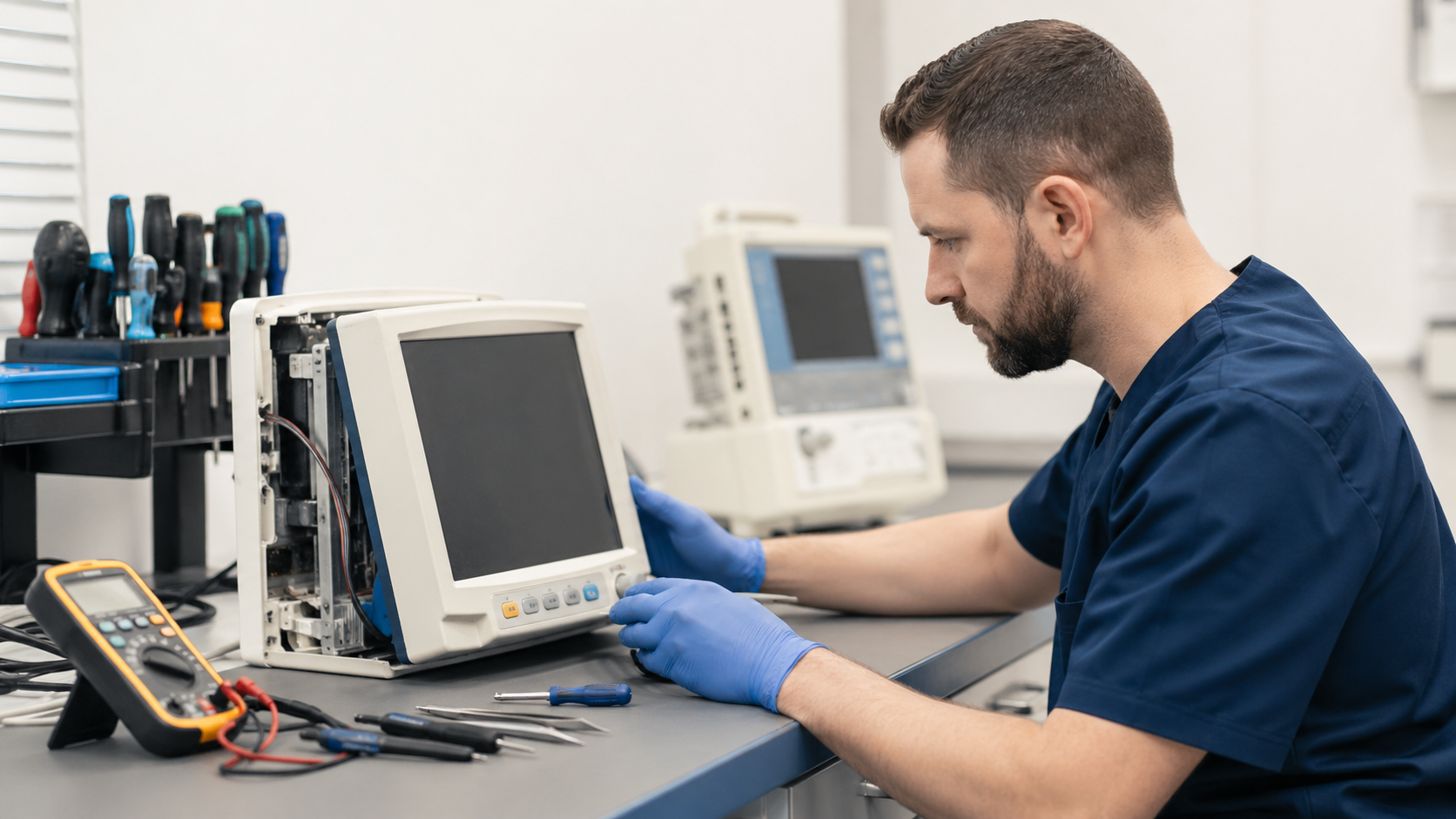
Medical equipment does not usually fail at a convenient time.
A monitor stops working during a busy day.
An imaging unit shows an error before a scheduled examination.
A laboratory device becomes unstable.
An operating room device no longer performs as expected.
In these situations, the first question is often simple:
Should the equipment be repaired, serviced, tested, or replaced?
The answer depends on the device, the fault, the availability of spare parts, the age of the equipment and the cost of downtime.
A good service process should not begin with random part replacement. It should begin with diagnosis. Before any repair decision is made, the device should be inspected, the reported fault should be checked and the technical condition should be understood.
At EMTrading, this is the basic approach behind our medical device service and repair: inspect first, repair where reasonable, test before return and document the result clearly.
If your equipment is currently out of service, showing repeated faults or waiting for inspection, EMTrading can help assess the next practical step.
Need a technical assessment for a faulty or unstable device?
Why Medical Equipment Service Should Start with Diagnosis
A visible fault is not always the real problem.
A device may fail because of a damaged cable, a worn connector, an unstable power supply, a defective sensor, contamination, software issues, mechanical wear or incorrect handling.
If the cause is not identified properly, the same problem may return after repair.
That is why diagnosis matters.
A structured diagnosis helps answer practical questions:
- Can the fault be reproduced?
- Is the problem caused by the main device or an accessory?
- Are spare parts available?
- Is the repair economically reasonable?
- Does the device need testing before it can be returned to use?
- Would replacement be the safer or more cost-effective option?
For healthcare facilities, this prevents unnecessary repair costs and reduces repeated downtime.
A weak service process asks: “Which part should we replace?”
A better service process asks: “What is actually causing the fault?”
That difference matters.
Repair, Maintenance and Testing: What Is the Difference?
maintenance, repair and testing are connected, but they are not the same.
Repair is corrective work. It is carried out when a device is damaged, faulty or no longer working as expected.
Maintenance is preventive or routine work. It helps reduce wear-related failures and keeps equipment more predictable during daily use.
Testing verifies the condition of the device after inspection, repair or maintenance. It helps confirm whether the equipment performs as expected before it is returned to use.
In practice, these steps often belong together.
A device may come in for repair. After repair, it should be tested. During inspection, additional maintenance needs may also become visible.
This is why a complete service approach is more useful than treating repair, maintenance and testing as separate topics.
Medical Imaging Equipment: Common Service Points
Medical imaging equipment is often expensive, sensitive and important for daily scheduling. Even small faults can delay examinations and affect patient appointments.
Common service points may include:
- image quality problems
- startup or system errors
- display or interface issues
- damaged cables or connectors
- sensor or detector-related faults
- mechanical movement problems
- power supply issues
- accessory-related problems
Before deciding on repair, the device should be inspected carefully. The reported fault should be reproduced where possible. Accessories should also be checked, because the problem is not always inside the main unit.
For used or refurbished imaging equipment, functional testing is especially important. Buyers need to know whether the device has been checked properly, not only cleaned and photographed.
A proper service decision should consider the fault, spare part availability, expected repair cost and whether the equipment still fits the facility’s clinical needs.
Patient Monitoring and Diagnostic Equipment: What Should Be Checked?
Patient monitoring and diagnostic equipment is used in direct clinical workflows. Stable function is therefore important.
Common issues may include:
- display failure
- battery problems
- damaged patient cables
- defective sensors or probes
- unstable readings
- alarm issues
- connection problems
- printer or interface faults
- power supply defects
In many cases, accessories are part of the problem. A patient monitor may appear faulty when the actual issue is caused by a cable, sensor, battery or connector.
That is why service should include more than a basic power-on check.
A practical inspection should check the main device, relevant accessories, visible damage, error messages, power behavior and basic function. After repair, the device should be tested again to confirm that the reported issue has been resolved.
For healthcare facilities, this reduces the risk of returning equipment to use too early.
Laboratory Equipment: Why Stability Matters
Laboratory equipment often fails differently from other medical devices.
The device may still turn on, but its performance may no longer be stable.
This is a serious issue.
A laboratory device that appears functional but gives unstable or unreliable results can create bigger problems than a device that simply does not start.
Common service points may include:
- temperature instability
- calibration-related issues
- mechanical wear
- sensor problems
- software or interface errors
- contamination-related faults
- power supply issues
- display or control problems
For laboratory equipment, service should focus on function, repeatability and stability. The goal is not only to make the device run again. The goal is to understand whether it can still perform its task properly.
If the device cannot be restored to dependable operation, replacement may be more reasonable than repair.
Operating Room Equipment: Service Before Downtime Becomes Critical
Operating room equipment is different from general equipment because downtime can affect scheduled procedures.
OR equipment may include surgical lights, tables, electrosurgical devices, suction units, endoscopy-related systems, monitors, pumps or other supporting devices.
Common problems may include:
- unstable output
- damaged cables
- mechanical wear
- faulty switches or controls
- power issues
- weak illumination
- loose arms or joints
- connector problems
- accessory defects
- error messages
In the OR, small problems can become serious operational issues. A loose joint, unstable light output or intermittent electrical fault may not stop the device immediately, but it can make daily use unreliable.
This is why preventive maintenance and functional testing are important for OR equipment.
The device should be inspected before failure becomes urgent. If a fault is already present, repair should be followed by testing and clear documentation.
Mobility Equipment: Mechanical Wear, Safety and Function
Mobility equipment is often exposed to frequent movement, weight load and daily handling. This makes mechanical wear a central service issue.
Common service points may include:
- brake problems
- wheel or caster wear
- battery issues
- motor problems
- frame damage
- loose components
- control problems
- charging issues
- mechanical instability
- damaged upholstery or support elements
For mobility equipment, service is not only about whether the device moves. It is about whether it moves safely and predictably.
A practical inspection should check visible damage, mechanical stability, brakes, wheels, controls, batteries where applicable and overall function.
If the equipment is used in a clinic, care facility or hospital, downtime can create immediate workflow problems. Preventive inspection can help identify wear before failure occurs.
When Is Repair Still Worth It?
Repair is usually worth considering when the fault is clearly identified, spare parts are available, the repair cost is reasonable and the equipment still has practical value for the facility.
Repair can also make sense when the device is already familiar to the clinical team, fits existing workflows and can be returned to stable operation without excessive cost.
However, repair is not always the best decision.
Replacement may be more reasonable when spare parts are difficult to obtain, the same fault keeps returning, repair costs are too high or the device no longer fits the facility’s needs.
This decision should be based on inspection, not guesswork.
A professional diagnosis helps healthcare facilities avoid two common mistakes:
- replacing equipment too early
- repairing equipment that should no longer be repaired
If you are unsure whether repair still makes sense, EMTrading can review the device model, fault description and available photos.
Not sure whether repair still makes sense? Send us the device model, fault description and available photos.
What a Proper Service Report Should Include
A service report is not just paperwork.
It gives the healthcare facility a clear record of what was checked, what was repaired and what the final result was.
A useful service report should include:
- device identification
- reported fault
- inspection result
- repair action
- parts replaced, if applicable
- tests performed
- final result
- recommendation for further use, repair or replacement
This documentation helps with internal records, equipment planning and future service decisions.
For used and refurbished medical equipment, documentation is especially important. A device should be described honestly and supported by clear inspection and testing information.
A device should not only look acceptable. It should be checked, tested where applicable and prepared for practical use.
How EMTrading Supports Medical Equipment Service, Repair and Testing
EMTrading supports healthcare facilities, clinics, hospitals and equipment buyers with service, repair, maintenance and testing for selected medical equipment categories.
These include:
- medical imaging
- patient monitoring and diagnostics
- laboratory equipment
- operating room and OR equipment
- mobility equipment
The process starts with inspection and diagnosis. Where repair is reasonable, the required service work is carried out. Afterward, the equipment is checked and documented before it is returned, resold or prepared for further use.
This approach is especially useful for facilities that want to reduce downtime, extend the useful life of equipment and make better repair-or-replace decisions.
For more details, visit our medical device service and repair page.
Need Support with Medical Equipment Repair, Maintenance or Testing?
If a device is faulty, unstable or no longer performing as expected, the first step should be a clear technical assessment.
You can contact EMTrading with the device model, fault description and available photos. We will review the case and advise whether repair, maintenance, testing or replacement should be considered.
This helps you avoid unnecessary repair costs, reduce downtime and make a better service decision.
Ready to review a service case or repair request?
FAQ
What is the difference between medical equipment repair and maintenance?
Medical equipment repair is corrective work after a fault has occurred. Maintenance is planned or preventive work intended to reduce the risk of failure. Repair fixes an existing problem. Maintenance helps keep equipment stable and predictable.
When should medical equipment be tested?
Medical equipment should be tested after repair, after maintenance, after replacement of relevant parts, after transport or storage, before resale, or when performance is uncertain. The type of testing depends on the device category and the service performed.
Is repair always better than replacing medical equipment?
No. Repair is not always the best option. If spare parts are unavailable, the repair cost is too high, the same fault keeps returning, or the device no longer fits the facility’s needs, replacement may be more reasonable.
Why is diagnosis important before repair?
Diagnosis helps identify the real cause of the problem. Without diagnosis, parts may be replaced unnecessarily, and the same fault may return. A proper diagnosis supports better repair decisions and helps reduce repeated downtime.
What types of medical equipment does EMTrading service?
EMTrading provides service, repair, maintenance and testing support for selected equipment categories, including medical imaging, patient monitoring and diagnostics, laboratory equipment, operating room equipment and mobility equipment.
Why is a service report important?
A service report documents the reported fault, inspection result, repair work, parts replaced, tests performed and final result. It gives healthcare facilities a clear record of what was done and supports future service or replacement decisions.
Can used or refurbished medical equipment be repaired and tested before resale?
Yes. Used or refurbished medical equipment should be inspected and tested before resale. This helps buyers understand the condition of the equipment and reduces the risk of unexpected problems after purchase.


Ratings and Reviews